Below is your observing guide for July and August 2026.
As spring transitions to summer in the northern hemisphere, the nights become shorter but warmer, offering comfortable observing conditions. This guide highlights some of the better targets you should plan to observe. While it doesn’t list all targets, it will give you a good starting point.
For those in the southern hemisphere, longer, cooler nights offer excellent opportunities for extended observing sessions.
If you didn’t follow our observing guide for May and June 2026, it is not too late to catch some of those targets.
How to Use This Observing Guide
The observing guide lists eight categories of astronomical features that may be observed. These are: key constellations, objects near each celestial pole, the Moon and its phases, planets that will be visible, eclipses, conjunctions, meteor showers and comets. Don’t worry if you don’t know what these are, as there are explanations for each.
Where possible, it is indicated if each target is visible to the naked eye, using binoculars or if a telescope is required.
The observation guide includes tips for observing each type of object.
To set to local time click icon indicated
To aid your sessions, we have included links to each object in the web version of Stellarium. You can click on the highlighted text or the constellation images. If, for some reason, the link doesn’t work, but you arrive at Stellarium, search for the object in the search bar. To change the time to your current time, click on the time in the lower right and click on the small clock between the date and the time, as circled to the right.
Due to time zones, the timing of conjunctions at the time of the closest approach depends on your time zone. As such, the link may not take you to when the two bodies are at their closest.
If you are very new to stargazing, we suggest first identifying the constellations detailed below. Locate them and trace out their shape. This will help you learn to navigate the night sky. The time spent will make things much easier when you attempt to locate smaller and fainter targets.
If possible, you should attempt to find a dark site. This will allow you to see all of the targets below. In a large city, the bright sky will wash out all but the brightest objects.
As always, allowing your eyes to become dark-adapted is a good idea. This can take 30 minutes. During this time, you can study the brighter stars. Remember to use red light and/or a dark theme on any devices you use.
For dimmer objects, averted vision. We instinctively look directly at what we wish to see. This places the object in the area of the eye that sees color best and in sharp detail. However, it is not the most sensitive part of the eye. To see dim objects, avert your eyes a little. Experiment with averted vision to find where the best spot is for you.
Unless otherwise noted, all photographs of celestial objects in the observation guide are taken by the author. They were either taken through a moderately sized refracting telescope or using a DSLR on a tripod. Keep in mind that these photographs are long exposure and are enhanced. They do not present what you will see with the naked eye.
Seasonal Highlights
July and August offer some of the finest evening skies of the year, with several large-scale features that make this period particularly rewarding for observers.
The Milky Way is high in the sky. During these months, the brightest and richest portion of our galaxy arches overhead from late evening onward. The galactic centre lies in the direction of Sagittarius and Scorpius, where the Milky Way’s star clouds appear at their densest and most luminous. From a dark site, the band of light stretches from the southern horizon through Aquila and Cygnus to Cassiopeia in the north, offering breathtaking naked-eye views and an embarrassment of riches for binoculars.
The Summer Triangle dominates the eastern and overhead sky. This vast asterism, formed by Vega (in Lyra), Deneb (in Cygnus), and Altair (in Aquila), serves as a signpost for navigating the summer constellations and contains a wealth of deep-sky objects within its bounds.
The galactic centre region is at its best. The area around Sagittarius and Scorpius hosts an extraordinary concentration of globular clusters, emission nebulae, and open clusters, more than any other region of sky. Observers in the southern hemisphere and southern latitudes of the northern hemisphere enjoy the most favourable views, with these constellations climbing high overhead.
The “Great Rift” is prominent. Running through the Milky Way from Cygnus down through Aquila and into Sagittarius, this dark band of interstellar dust appears to split the galactic plane in two. It is visible to the naked eye from dark locations and is one of the most striking features of the summer sky.
Noctilucent clouds may be visible from mid- to high northern latitudes during late evening and pre-dawn hours. These rare, electric-blue clouds form at the edge of space and are best seen in June and July.
Key Constellations
Lyra
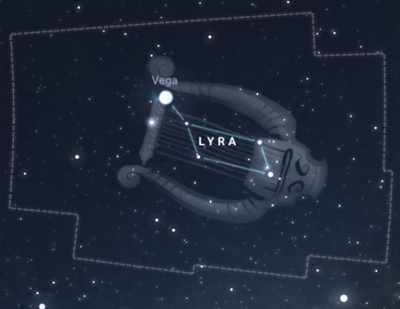
Lyra, the Lyre, is a small but prominent northern constellation dominated by the brilliant star Vega. Although compact, Lyra contains one of the most famous planetary nebulae in the sky and several other rewarding targets. Its distinctive parallelogram shape, anchored by Vega at one corner, makes it easy to locate high overhead on July and August evenings.
Naked eye:
Vega (α Lyrae): Fifth brightest star in the night sky and a corner of the Summer Triangle
The distinctive parallelogram pattern of the lyre
Binoculars:
Epsilon Lyrae: The famous “Double Double,” appearing as a wide pair
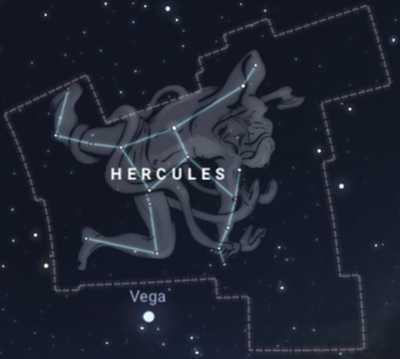
Hercules is a large northern constellation best visible on summer evenings, occupying the sky between Lyra and Corona Borealis. Though it lacks first-magnitude stars, Hercules is home to one of the finest globular clusters in the northern sky, and its distinctive “Keystone” asterism makes it easy to identify high overhead.
Naked eye:
Kornephoros (β Herculis): The brightest star in the constellation
The Keystone: A trapezoidal asterism of four stars forming the hero’s torso
Binoculars:
M13 (Great Hercules Cluster): Appears as a bright fuzzy patch on the western edge of the Keystone
M92: Another fine globular cluster, often overlooked due to M13’s fame
Small telescope:
M13: Resolves into a spectacular swarm of countless stars
M92: Compact and brilliant, with a tightly concentrated core
Rasalgethi (α Herculis): Beautiful double star with contrasting orange and blue-green components
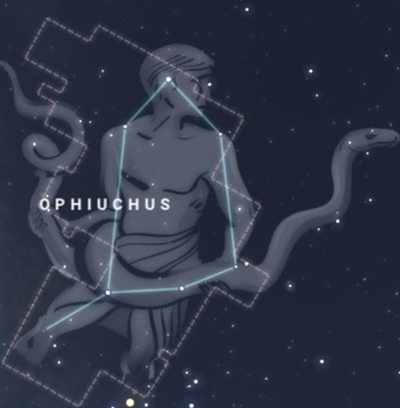
Ophiuchus, the Serpent Bearer, is a large equatorial constellation that straddles the Milky Way between Hercules and Scorpius. Often overlooked despite its size, Ophiuchus is exceptionally rich in globular clusters, with more Messier globulars than any other constellation. The Sun actually passes through Ophiuchus in late November and early December, making it an unofficial thirteenth zodiac constellation.
Naked eye:
Rasalhague (α Ophiuchi): The brightest star, marking the head of the serpent bearer
The large, rounded shape of the constellation between Hercules and Scorpius
Binoculars:
M10 and M12: A fine pair of globular clusters in the same field of view
M9, M14, M19, M62: Additional globular clusters scattered through the constellation
Small telescope:
M10 and M12: Resolve into individual stars with good contrast
Barnard’s Star: One of the closest stars to the Sun and the fastest-moving star in the sky
70 Ophiuchi: Beautiful binary star with yellow and orange components
Scutum
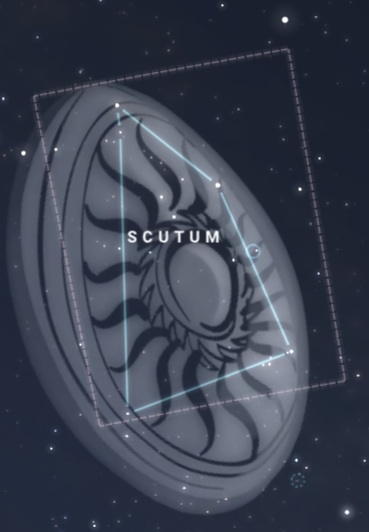
Scutum, the Shield, is a small but remarkable constellation tucked between Aquila and Sagittarius. Though one of the smallest constellations, it lies in one of the richest parts of the Milky Way and contains the magnificent Scutum Star Cloud, one of the brightest patches of the entire galactic band.
The Scutum Star Cloud: A dense, luminous region of the Milky Way visible from dark sites
Binoculars:
M11 (Wild Duck Cluster): Brilliant, dense open cluster resembling a flock of ducks in flight
M26: Smaller but rewarding open cluster
The Scutum Star Cloud: Revealed as countless stars across the field
Small telescope:
M11: Resolves into a spectacular fan of stars with a prominent member at its centre
M26: Shows perhaps a dozen brighter members against a rich background
R Scuti: Notable variable star with irregular brightness changes
Aquila
Aquila, the Eagle, is a prominent constellation lying along the Milky Way, with its brightest star Altair forming one corner of the Summer Triangle. The constellation’s compact, distinctive shape resembles an eagle in flight, and its position in a rich region of the galactic plane makes it a fine area for sweeping with binoculars.
Naked eye:
Altair (α Aquilae): Twelfth brightest star in the night sky and corner of the Summer Triangle
The distinctive line of three stars (Altair flanked by Alshain and Tarazed) forming the eagle’s head and shoulders
Sagittarius, the Archer, is a magnificent southern constellation that hosts the centre of our galaxy. Best visible from southern latitudes where it climbs higher in the sky, this constellation is unparalleled in the variety and richness of its deep-sky objects. The distinctive “Teapot” asterism makes it easy to recognise, and the “steam” rising from its spout is the densest portion of the Milky Way.
Naked eye:
Kaus Australis (ε Sagittarii): The brightest star in the constellation
The Teapot: Famous asterism formed by the eight brightest stars
The galactic centre region: Densest part of the Milky Way visible from dark sites
Binoculars:
M8 (Lagoon Nebula): Large, bright emission nebula with embedded cluster
M17 (Omega or Swan Nebula): Striking emission nebula
M22: One of the finest globular clusters in the sky
M23, M24 (Sagittarius Star Cloud), M25: Beautiful star fields and clusters
Small telescope:
M8: Reveals intricate detail, dark lanes, and the open cluster NGC 6530
M20 (Trifid Nebula): Shows the characteristic three-lobed structure with dark dust lanes
Serpens Cauda, the tail of the celestial serpent, is the eastern portion of the divided Serpens constellation, lying on the opposite side of Ophiuchus from Serpens Caput. This region of the Milky Way contains one of the most photographed nebulae in the sky, making it a highlight of any summer observing session.
Naked eye:
Eta Serpentis: Orange giant marking part of the serpent’s tail
The star field along the Milky Way passing through the constellation
Binoculars:
M16 (Eagle Nebula): Open cluster surrounded by nebulosity, appearing as a hazy patch
M16: Reveals the open cluster clearly, with the surrounding Eagle Nebula visible from dark sites, made famous by the Hubble image known as the “Pillars of Creation”
Theta Serpentis (Alya): Beautiful double star with two near-identical white components
Scorpius
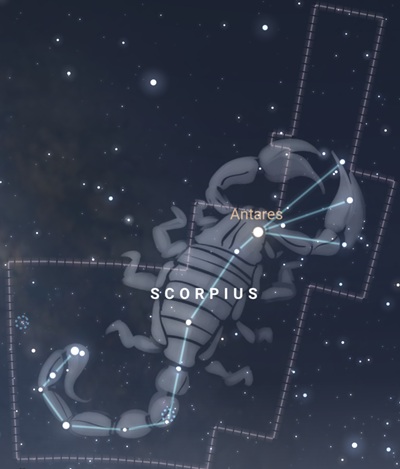
Scorpius, the Scorpion, is one of the few constellations that genuinely resembles its namesake, with a curving line of bright stars tracing the body and tail. Best visible from southern latitudes, where it climbs high in the sky, Scorpius lies along the Milky Way and is packed with deep-sky treasures. Its brightest star, Antares, is a brilliant red supergiant.
Naked eye:
Antares (α Scorpii): Sixteenth brightest star in the night sky, a red supergiant whose name means “rival of Mars”
The graceful curving shape of the scorpion’s body and tail
Shaula (λ Scorpii) and Lesath (υ Scorpii): The “stinger” stars at the tail’s tip
M6 (Butterfly Cluster) and M7 (Ptolemy Cluster): Two of the finest open clusters in the sky
NGC 6231: Brilliant young open cluster near Zeta Scorpii
Small telescope:
M4: Resolves into a loose globular with a distinctive bar of stars across its centre
M6: Reveals its butterfly-like shape with contrasting colours among the brighter stars
M7: Spectacular, filling the field with bright stars
Antares: Shows a faint green companion, a challenging but rewarding double
NGC 6302 (Bug Nebula): Planetary nebula with intricate bipolar structure
Sagitta
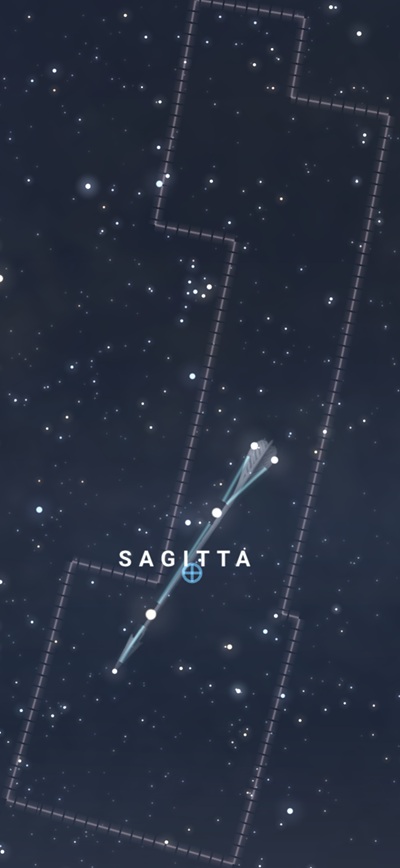
Sagitta, the Arrow, is the third-smallest constellation in the sky, but its compact, unmistakable arrow shape makes it surprisingly easy to find within the Summer Triangle. Despite its small size, Sagitta lies in a rich part of the Milky Way and contains a few rewarding targets.
Naked eye:
Gamma Sagittae: The brightest star, an orange giant marking the arrowhead
The distinctive four-star arrow shape
Binoculars:
M71: Loose globular cluster, sometimes mistaken for a rich open cluster
The Milky Way star fields surrounding the constellation
The northern celestial pole region remains relatively unchanged from previous months, offering consistent circumpolar targets for observation. The primary marker remains Polaris, the North Star, which stays nearly stationary while other stars appear to rotate around it.
For southern hemisphere observers, the summer months of January and February offer excellent views of the southern celestial pole region and its rich collection of objects.
New Moon: Best time for observing faint deep-sky objects and meteor showers
First Quarter & Last Quarter: Good for observing lunar features along the terminator
Full Moon: Ideal for observing lunar maria and bright ray systems
Visible Planets in July and August 2026
Mercury:
Best evening viewing occurs during the first week of July low in the western sky after sunset
Shifts to the morning sky by mid-August, visible low in the eastern sky just before sunrise
Highly unique viewing opportunity: Visible near the sun during the Total Solar Eclipse on August 12 (requires telescope/binoculars safely during totality)
Venus:
Brilliant “Evening Star” dominating the western sky after sunset
Reaches Greatest Eastern Elongation on August 15, staying well above the horizon into the early evening
Gradually climbs higher and brightens significantly throughout both months
Mars:
Visible in the morning sky, rising a few hours before the Sun
Steadily moves through Taurus and into Gemini over this period
Appears as a distinct, moderately bright orange-red “star” in the early pre-dawn hours
Jupiter:
Returns prominently to the morning sky after its June conjunction
Rises progressively earlier in the east-northeast, shining brilliantly in Gemini before dawn
Well-placed for telescope observation by late August, showing up high in the sky before sunrise
Saturn:
Visible for most of the night, rising in the mid-evening in July and by sunset by late August
Approaching its upcoming opposition, offering prime viewing conditions in the constellation Aquarius
Noticeable to telescope users for its incredibly narrow, almost edge-on ring profile
Uranus:
Well placed in the morning sky within the constellation Taurus
Best viewed after midnight using binoculars or a small telescope
Located several degrees away from Mars in late July, making it easier to track down with sky charts
Neptune:
Visible almost all night long in the constellation Pisces, rising by late evening
Requires a telescope or high-powered binoculars to spot as a faint magnitude 7.8 blue disk
Positions itself beautifully high in the dark morning skies before dawn twilight breaks
The path of totality sweeps across the Arctic Ocean, Greenland, Iceland, the Atlantic Ocean, and Northern Spain National Solar Observatory
A deep partial solar eclipse will cover up to 90% of the sun for observers in the United Kingdom, Ireland, and western Europe Royal Museums Greenwich
Observers along the path will get a rare mid-afternoon or sunset view of the sun’s corona, alongside bright planets like Venus, Mercury, and Jupiter becoming visible in daytime
Occurs exactly two weeks after the solar eclipse during the Full Moon phase
This is a very deep partial eclipse, with roughly 93% of the Moon’s disk slipping into the Earth’s dark umbral shadow
Fully visible across North America, South America, Europe, Africa, and parts of the Middle East, giving the lower portion of the moon a dark reddish tint
Notable Conjunctions in July and August 2026
July 2026:
Moon-Saturn Conjunction (July 4): A close pre-dawn grouping in Aquarius
Moon-Jupiter Conjunction (July 11): Brilliant crescent moon pairs with Jupiter in the morning sky
Moon-Venus Conjunction (July 17): A stunning, razor-thin waxing crescent moon sits close to bright Venus in the western twilight
Mars-Aldebaran Conjunction (July 20): Mars passes very close to the bright red giant star Aldebaran in Taurus, creating a beautiful color match of two red objects
August 2026:
Moon-Jupiter Conjunction (August 8): A bright early morning pairing in the constellation Gemini
Eclipse Daytime Alignment (August 12): During the solar eclipse totality, Mercury and Jupiter align closely just west of the blacked-out sun, while Venus shines brilliantly further to the southeast
Moon-Venus Conjunction (August 16): Venus and a fat waxing crescent moon create a show-stopping pair high in the western evening sky
Moon-Saturn Conjunction (August 27): The nearly full moon pairs up closely with Saturn, lighting up the sky right before the partial lunar eclipse the following morning
Observing Tips for Conjunctions
Lunar conjunctions are visible to the naked eye. They provide excellent opportunities for astrophotography.
For planetary conjunctions, binoculars can enhance the view, allowing you to see both objects in the same field of view.
Conjunctions involving Uranus are good opportunities to locate this faint planet using the much more visible Moon as a guide. Use binoculars or a small telescope.
While these conjunctions are visible from most locations on Earth, the exact appearance and timing can vary slightly depending on your specific location. Always check local astronomical resources for precise timing and visibility information.
Remember, conjunctions are line-of-sight events. The objects aren’t actually close to each other in space, they just appear close from our viewpoint on Earth.
When clicking the links to view the event in Stellarium remember to ensure that your location and time are set correctly.
Note: This list includes the most notable conjunctions. There may be additional, less prominent conjunctions during this period. Check astronomical almanacs or reliable online sources closer to the date for a complete list and for the most accurate timing information
Meteor Showers in July and August 2026
Delta Aquariids (Southern):
Active period: July 12 – August 23 Royal Museums Greenwich
Peak: July 30, 2026 Royal Museums Greenwich
Parent body: Comet 96P/Machholz (probable) Royal Museums Greenwich
ZHR: 25 (best viewed from the southern hemisphere and southern latitudes) In-The-Sky.org
Notes: Medium-speed meteors with a broad maximum. Critical 2026 Warning: The moon will be 98% full during the peak night, which will severely wash out these faint meteors. Observers will need to rely on catching a few brighter ones against the moonlit sky. Farmer’s Almanac
Alpha Capricornids:
Active period: July 3 – August 15 In-The-Sky.org
Peak: July 30, 2026 In-The-Sky.org
Parent body: Comet 169P/NEAT International Meteor Organization
ZHR: 5
Notes: Slow-moving meteors known for producing bright, colourful fireballs. While the rate is low, the quality of individual meteors is excellent. 2026 Observing Note: Despite the heavy interference from the 98% full moon, the bright fireballs produced by this shower are often powerful enough to cut through the moonlight.
Perseids:
Active period: July 17 – August 24 Royal Museums Greenwich
Peak: August 12–13, 2026 EarthSky
Parent body: Comet 109P/Swift-Tuttle Skylook.org
ZHR: 100 (best viewed from the northern hemisphere)
Notes: One of the most reliable and prolific showers of the year, featuring fast meteors that frequently produce bright fireballs and persistent trains. Perfect 2026 Conditions: The peak lines up flawlessly with a New Moon on August 12, offering completely dark, moon-free skies for maximum visibility from midnight until dawn. Skylook.org
Kappa Cygnids:
Active period: August 3 – August 25
Peak: August 17–18, 2026
Parent body: Unknown (possibly asteroid 2008 ED69)
ZHR: 3
Notes: Slow meteors with occasional bright fireballs. The radiant is circumpolar from mid-northern latitudes, meaning it stays above the horizon all night. 2026 Observing Note: Great conditions this year, as the waxing crescent moon will set early in the evening, leaving dark skies for the remainder of the night.
Observing Tips for Meteor Showers
Choose a dark site away from city lights
Check the Moon phase as a bright Moon may wash many meteors out
Allow 30 minutes for dark adaptation
Use a reclining chair or blanket
Best viewing typically after midnight
No optical aid needed
Be patient – activity comes in spurts
Comets
Comet 10P/Tempel 2:
Can be found moving through the constellation Aquarius during late June and July, transitioning into Capricornus by early August
Reaches perihelion on August 2, 2026, and makes its closest approach to Earth on August 3–4 at 0.414 AU
Predicted to peak at roughly magnitude 7.0, making it an excellent target for binoculars or small telescopes under dark skies
I found astronomy while working in dark rural locations. Initially, I explored the night sky and learnt the constellations before purchasing a pair of binoculars to further my knowledge of the sky.
My first telescope was a 200 mm Newtonian reflector on an equatorial mount. I found that this telescope had a steep learning curve but was a rewarding experience.
As time progressed, I became interested in astrophotography. This resulted in purchasing a 110 mm refracting telescope and a dedicated monochrome-cooled astronomical camera. This resulted in another very rewarding steep learning curve that far surpassed the experience with my first telescope.
I have joined Telescope Guru to share my knowledge of telescopes and astronomy.