The next lunar eclipse will occur during the night of August 27 to 28, 2026. It will bring one of nature’s most engaging celestial displays to skies across the Americas, Europe, Africa, and Antarctica: a deep partial lunar eclipse. At greatest eclipse, more than 93% of the Moon’s disc will be plunged into Earth’s umbral shadow, so deeply that the spectacle will closely resemble a total eclipse, with much of the Moon taking on the characteristic reddish hue often called a “Blood Moon.”
Timing and Visibility
This partial lunar eclipse will begin with the penumbral phase at approximately 1:24 UTC on August 28, 2026, though the subtle dimming may be difficult for casual observers to detect. The more noticeable partial eclipse will begin at 2:33 UTC when the Moon starts to enter Earth’s umbral shadow.
Greatest eclipse will occur at 4:13 UTC, when about 93% of the Moon will be immersed in Earth’s umbra. The remaining sliver of the Moon will sit in the lighter penumbra, producing a striking contrast: most of the disc will glow in deep coppery red, while a bright crescent along the northeastern limb stays comparatively pale. The partial phase will end at 5:53 UTC, and the eclipse will conclude with the penumbral phase at 7:02 UTC, giving an overall duration of around 5 hours and 38 minutes.
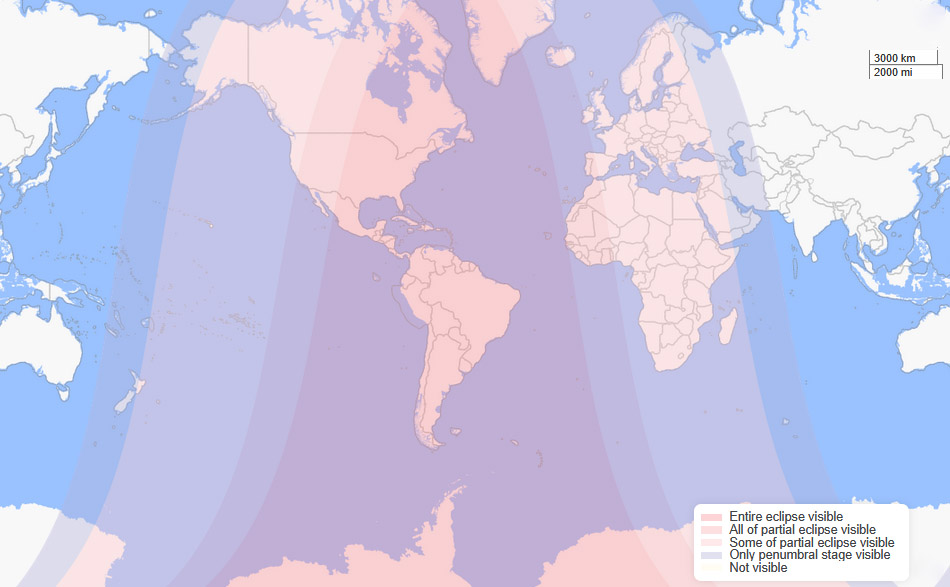
The eclipse will be best seen from the Americas, where the entire event will be visible from start to finish with the Moon high in the sky. Observers in western Europe, west Africa, and the Atlantic will see the Moon setting with the eclipse already underway. Those in eastern Europe, the Middle East, and eastern Africa will catch only the opening stages before moonset. The image below shows where the eclipse will be visible and what parts of it will be visible from each region.
What Makes This Eclipse Special
The August 2026 eclipse is notable for several reasons:
Almost a total eclipse: With 93% of the Moon entering Earth’s umbra, this is one of the deepest partial lunar eclipses possible. Near maximum, the eclipse will look very nearly total, displaying the red glow of totality across most of the lunar surface alongside a bright sliver still in the penumbra.
Pairs with the August 12 solar eclipse: This eclipse falls exactly two weeks after the total solar eclipse of August 12, 2026. Both events are part of the same eclipse season, illustrating the way solar and lunar eclipses tend to occur in pairs separated by about a fortnight.
Last lunar eclipse until 2027: No further lunar eclipses will occur in 2026 after this one. The next lunar eclipse will be a penumbral event in February 2027, which will be much harder to observe.
Last full lunar eclipse until 2028: The next total lunar eclipse will span the change from 2028 to 2029. That’s right, it will span New Year’s.
What to Look For
As you observe this lunar eclipse, pay attention to:
Colour Variations: During the deepest phase of the eclipse, the portion of the Moon within the umbra may display different shades of red, orange, and brown across its surface, reflecting variations in Earth’s atmosphere at different locations.
The Bright Limb: Because a small sliver of the Moon remains outside the umbra, look for the dramatic contrast between the bright northeastern edge and the deeply reddened remainder of the disc — a striking sight unique to deep partial eclipses.
High-Contrast Spectacle: Because a thin sliver of the Moon remains outside the umbra throughout the eclipse, the bright northeastern limb will glare against the deep red of the shadowed surface. This dramatic contrast is unique to deep partial eclipses — the exposed edge is dazzling enough that it can overwhelm the eye and make the reddened portion harder to appreciate. Try briefly blocking the bright limb with a finger or thumb at arm’s length to let your eyes adjust, then take in the full disc.
Star Visibility: During the deepest phase, the dimmed Moon allows stars to become more visible in its vicinity. The eclipse takes place while the Moon is in the constellation Aquarius, offering a unique perspective on a quieter region of the sky.
Future Lunar Eclipse
The following lunar eclipse will occur in February 2027. It will be a penumbral eclipse and will therefore be considerably more subtle than this one. This page will be updated soon after the August 27–28 eclipse.
Future Lunar Eclipse
The following lunar eclipse will occur in early September. It will also be a total lunar eclipse. This page will be updated soon after the March 13-14 eclipse.
The Science Behind Lunar Eclipses
A lunar eclipse occurs when Earth positions itself directly between the Sun and Moon, casting its shadow across the lunar surface. Unlike solar eclipses that require special viewing equipment, lunar eclipses are completely safe to observe with the naked eye.
The alignment necessary for a lunar eclipse—known as syzygy—can only happen during a full moon, but not every full moon produces an eclipse. This is because the Moon’s orbit around Earth is tilted by about 5 degrees relative to Earth’s orbit around the Sun. As a result, the Moon usually passes above or below Earth’s shadow each month. A lunar eclipse only occurs when the full moon phase coincides with the Moon crossing the plane of Earth’s orbit.
Earth’s shadow consists of two parts (see image below):
The umbra: the darker, inner portion where direct sunlight is completely blocked
The penumbra: the lighter, outer portion where sunlight is partially blocked
This shadow structure creates three distinct types of lunar eclipses:
Total Lunar Eclipse: The Moon passes completely through Earth’s umbral shadow, often turning a spectacular reddish-copper color.
Partial Lunar Eclipse: Only a portion of the Moon enters Earth’s umbra, creating a partial darkening effect.
Penumbral Lunar Eclipse: The Moon passes through Earth’s penumbral shadow only, causing a subtle dimming that may be difficult for casual observers to notice.
The reddish appearance of the Moon during a total eclipse—often called a “Blood Moon”—is caused by Rayleigh scattering, the same phenomenon that makes sunrises and sunsets appear red. Earth’s atmosphere filters out shorter wavelengths (blues and greens) while allowing longer wavelengths (reds and oranges) to pass through and reflect off the lunar surface.
Lunar eclipses typically last several hours, with the totality phase of a total lunar eclipse lasting up to 100 minutes. They occur relatively frequently, with about 2-4 lunar eclipses happening annually, visible from large portions of Earth.
Historical Understanding of Lunar Eclipses
Ancient civilizations observed and recorded lunar eclipses long before understanding their scientific cause. Babylonian astronomers documented lunar eclipses on clay tablets as early as 750 BCE. By the 5th century BCE, Greek philosophers like Anaxagoras correctly suggested that lunar eclipses resulted from Earth’s shadow.
The Greek astronomer Hipparchus used a lunar eclipse in 129 BCE to calculate the distance from Earth to the Moon with remarkable accuracy for his time. Later, Ptolemy compiled eclipse records to develop his geocentric model of the solar system.
Perhaps most famously, Christopher Columbus used his knowledge of a predicted lunar eclipse on February 29, 1504, to convince Jamaican indigenous peoples to continue providing his crew with supplies, claiming he could “remove the moon” from the sky—a story that demonstrates both astronomical knowledge and its exploitation.
These historical observations gradually contributed to our scientific understanding, helping astronomers develop mathematical models of celestial motion that eventually led to our modern comprehension of the solar system.
Cultural Significance
Across cultures and throughout history, lunar eclipses have inspired profound mythological explanations:
Ancient Chinese believed a celestial dragon devoured the Moon during an eclipse, prompting people to bang drums and make loud noises to frighten the creature away.
Hindu mythology describes the demon Rahu drinking the elixir of immortality, with the severed head swallowing the Moon during eclipses.
The Inca thought a jaguar attacked and ate the Moon, explaining the blood-red color.
Some Native American tribes believed the eclipse represented a time of transformation and renewal.
Many cultures considered eclipses as omens—sometimes favorable, but more often warning of impending disasters or the displeasure of deities. These beliefs led to various rituals and practices during eclipses, including prayer, fasting, and remaining indoors.
Lunar eclipses have served as powerful symbols and dramatic devices in literature and art. From Shakespeare’s reference in King Lear to modern cinema, the darkened Moon continues to represent transformation, revelation, and cosmic disruption. Contemporary astrologers often associate lunar eclipses with emotional revelations and significant personal changes.
Observing a Lunar Eclipse
One of the most remarkable aspects of lunar eclipses is their accessibility. Unlike solar eclipses, which require specialized equipment to view safely, lunar eclipses can be observed directly without protective eyewear or special tools.
For the best viewing experience:
Find a location away from city lights with a clear view of the night sky
Check local weather forecasts to ensure clear conditions
Bring comfortable seating and warm clothing for potentially long viewing periods
Consider binoculars or a small telescope to observe details on the lunar surface during various eclipse phases
Photographers can capture stunning images of lunar eclipses with relatively simple equipment. A DSLR camera with a telephoto lens (at least 200mm) mounted on a tripod will yield impressive results. Various exposure settings should be tested throughout the eclipse, as the brightness of the Moon changes dramatically during the event.
During a total lunar eclipse, observers should note:
The gradual darkening as the Moon enters the Earth’s shadow
The reddish coloration during totality
The variation in color and brightness across the lunar surface
The gradual brightening as the Moon exits Earth’s shadow
Each lunar eclipse is unique, with variations in the Moon’s path through Earth’s shadow, atmospheric conditions on Earth, and even recent volcanic activity all affecting the appearance and color intensity.
Scientific Value
Modern scientists continue to use lunar eclipses for various research purposes:
Measuring Earth’s atmospheric composition by analyzing which wavelengths of light pass through to reach the Moon
Studying changes in the lunar surface temperature during eclipses
Observing how wildlife on Earth responds to the sudden darkness
Testing predictions of celestial mechanics
Citizen scientists also contribute valuable data during lunar eclipses through coordinated observation programs. These allow researchers to collect information from diverse geographical locations simultaneously, enhancing our understanding of atmospheric conditions and other variables.
Lunar Eclipses Compared to Solar Eclipses
While both lunar and solar eclipses involve the Sun, Earth, and Moon, they differ significantly:
Lunar Eclipse
Solar Eclipse
Earth between Sun and Moon
Moon between Sun and Earth
Visible from anywhere on Earth’s night side
Visible only along narrow path of totality
Safe to view directly
Requires special eye protection
Occurs only at full moon
Occurs only at new moon
Lasts several hours
Totality lasts minutes at most
Occurs 2-4 times per year
Total solar eclipses visible from any specific location approximately once every 375 years
This accessibility makes lunar eclipses more commonly experienced than the more dramatic but geographically limited solar eclipses.
Frequently Asked Questions
Can lunar eclipses happen during the day?
Since lunar eclipses only occur during a full moon, and the full moon rises as the sun sets, lunar eclipses typically happen during nighttime hours for a given location. However, they can be visible during dawn or dusk in some regions.
Do lunar eclipses affect human behavior?
While folklore has long associated full moons and lunar eclipses with unusual behavior, scientific studies have not found conclusive evidence supporting these claims. However, the disruption of natural light cycles might affect some wildlife behaviors.
How red will a blood moon appear?
The redness varies considerably between eclipses, ranging from bright copper to dark brick-red or even brownish. This variation depends on global atmospheric conditions, particularly dust, clouds, and pollution levels.
Can I see a lunar eclipse from anywhere?
If the Moon is above the horizon at your location during the eclipse, you can observe it. However, weather conditions and light pollution can affect visibility.
Conclusion
Lunar eclipses represent perfect examples of how cosmic events connect humanity across time and culture. From ancient astronomers recording clay tablet observations to modern observers sharing eclipse photos on social media, these celestial phenomena continue to unite us in wonder.
The next time you have the opportunity to witness a lunar eclipse, take a moment to consider both the scientific marvel and the cultural heritage embodied in this cosmic shadow play. As Earth’s shadow gradually transforms our familiar Moon, we participate in an astronomical tradition that spans millennia—a tradition that continues to inspire scientific discovery, cultural expression, and simple wonder at the mechanics of our solar system.
Whether viewed through sophisticated telescopes or with the naked eye from a backyard, lunar eclipses remind us of our place in the cosmos and the predictable yet magnificent rhythm of celestial bodies. They stand as accessible invitations to look upward and marvel at the dynamic dance of light and shadow that connects us to the universe beyond our world.
I found astronomy while working in dark rural locations. Initially, I explored the night sky and learnt the constellations before purchasing a pair of binoculars to further my knowledge of the sky.
My first telescope was a 200 mm Newtonian reflector on an equatorial mount. I found that this telescope had a steep learning curve but was a rewarding experience.
As time progressed, I became interested in astrophotography. This resulted in purchasing a 110 mm refracting telescope and a dedicated monochrome-cooled astronomical camera. This resulted in another very rewarding steep learning curve that far surpassed the experience with my first telescope.
I have joined Telescope Guru to share my knowledge of telescopes and astronomy.